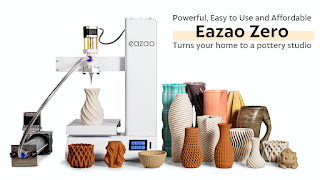
These pages are dedicated to introducing ceramic 3D printing to creative people at all skill levels and from differing backgrounds. So, when I find a YouTube video that I believe to be helpful, I want to include it and comment on my observations.
First, let me say I find the vast majority of reviews for new products to be utterly useless. Generally, the reviewer opens the box, tries the product, makes a video giving their reactions and then sets the product aside never to return to it. The video I am including in this post, byNathan Builds Robots is a refreshing departure from that formula!
Realistic First Time Expectations
Clay is not plastic.
Nathan could have edited out all of his startup hurdles. But, that would have deprived us of the reality of using a new 3D printer that uses an entirely new material. I really appreciated that Nathan walks us through each step including those that resulted in the kinds of failures that we need to overcome to be successful. Not only did Nathan learn from those bumps in the road, we learned, with him, how to put them behind us.
I came away believing that I just witnessed what I can realistically expect from my own first time experience with a ceramic 3D printer. This, alone, is enormously valuable. But, how Nathan proceeds through his learning curve is even MORE valuable.
Rewards of Tenacity
We constantly use 3D design and printing to emphasize the life lesson "Your Failures Are Not Final". You can bet we will show this video to our students because it show how we can turn failures into success by using critical thinking skills to come up with new solutions to try. We also use 3D design and printing to help students build "Resiliency" skills.
Nathan's tenacity is a great example of resiliency in action.
As we watch Nathan evaluate each printing attempt, we see him using the critical thinking skills that can turn that failure into developing a strategy to overcome that hurdle. Nathan wasn't content to print once and quit. He recorded repeated attempts over several days and every day brought about better and better results.
While he acknowledges that he has more to learn about the ceramic printing process, I look forward to future videos from Nathan as he continues to refine the ceramic 3D printing process.
Multi-machine Applicability
Another thing I appreciate about Nathan's video is that what he is experiencing and learning will have broad applicability across all of the new desktop ceramic 3D printers. The quest to find the right clay viscosity, flow pressure along with cleaning and firing tips will be useful to ALL of us, no matter which printer we end up purchasing. So, I, for one, have subscribed to his channel. I can't wait to see more.
The is no point in continuing to consider ceramic 3D printing if our life, or organizational, situation cannot implement every aspect of the workflow required to successfully integrate ceramics 3D printing into our goals.
This is probably not a complete description of the final workflow demanded of a user of a ceramic 3D printer. But, it will give us a good start at trying to determine how well we might be able to fulfill the basic requirements.
3D Design for Ceramics
Clay Selection & Procurement
Clay Preparation
3D Printing Process
Cleanup
Post-Printing Processing
Firing
Marketing (if applicable)
Anticipate Scalability
Obviously, this is a simplistic list of the elements of the workflow. But, it is a good start for taking a realistic look at our ability to truly implement ceramic 3D printing into our 3D printing goals for those we serve.
Workflow Requirement #1: 3D Design for Ceramics
Even the most talented traditional clay artist would fail to benefit from 3D printing if they could not find a way to create the virtual files from which to print. Fortunately, for us, we have found that our students enjoy using Moments of Inspirationto print with our traditional 3D printers, so at a bare minimum, we are confident that we can successfully meet the needs of this requirement.
But, it gets better than that. Quoting from the Eazao Blog:
"The major upgrade of the Eazao 3D printer this time is the software part. We cooperated with the Shandong University IRC Laboratory
to develop a series of software specifically for ceramic 3D printing,
which will greatly enhance the experience of Eazao 3D printers and lower
the entry barrier.
The software will be released for free in the near future. The
software is in the stage of intensive improvement. We integrate modeling
and slicing together to achieve a seamless connection between design
and manufacturing. It is currently divided into the following four
sections: sweeping modeling, lofting modeling, rotation modeling, and
texture mapping. At the same time, we also developed an interactive
modeling tool based on leapmotion."
The development version of this software is available for free download atClayontec.com. I have downloaded the software and, while it is not yet complete, I am convinced that ANYONE will be able to use this software to design almost unlimited designs suitable for meeting this requirement. It's remarkable software that produces very complex designs with very simple controls.Equally importantly, it can even be used to add material qualities to designs our students have created in MOI3D or any other CAD/3D Design program.
In the past, the question about whether or not an individual might have the skills to design clay vessels for a 3D printing was probably the biggest barrier to adoption of 3D ceramic printing. But, thankfully, Clayon goes a LONG way to make this particular question almost moot.
Not every clay will work well in a 3D printer. Before buying the printer it is important that we ensure we have the information we need to select the proper clay for our 3D printing needs.We are fortunate that Manassas Clay is nearby and we enjoyed working with them when we explored powder-binder ceramic printing.
For those not having a great resource like this locally, the good news is that ceramics 3D printing is not a new technology, even if consumer desktop ceramic 3D printing is new. There are many articles by skilled 3D ceramic printer users that clearly spell out the kinds of clay appropriate for 3D printers. We will cover this topic extensively in the future.
This is one of the most serious questions we need to ask ourselves before fully committing to incorporate ceramics into our 3D printing environment. The first step is to admit the challenges. The next step is to ensure we have come up with effect ways to meet those challenges.
There are videos and articles that can help us understand the clay preparation process. So, that does not concern us.
The real issue has to do with effects of introducing clay, itself, into our environment. Let's face it. Clay can be messy.
Part of our responsibility is to ensure that we have planned the processes to minimize negative aspects of using clay. This includes identifying equipment to keep the area clean and safe. We're ahead of the game in this regard because we already had to deal with the impact of using fine clay powders, which are far more potentially harmful than working with moist clay. We found many ways to use our regular 3D printers to create tools to help us keep our space as clean as possible.
Notice that I emphasized the word "fully" above. Some of our mitigation strategies might require obtaining a single printer for testing before we can fully understand what it will take to introduce it as an essential element of our program.
Workflow Requirement #3: 3D Printing Process
What is required for feeling confident with this step is going to be quite different from person to person.
We know that printing with ceramics, while similar to that of printing with plastic will have its own unique requirements. But, we not only have FDM printing experience; but, powder-binder and SLA technologies as well. Each of these have their own challenges and learning curves. But, we have always treated our learning space as a LAB. For this reason, we're confident that not only can we learn to use the ceramic 3D printer; but, thrive with using it.
For those with NO 3D printing experience, the Clayon software, mentioned earlier, combines both design and preparation of the files used by the printer. It even has a special functionality where it will test a design and report the likelihood of printing success.
Clayon Evaluation Report
This makes it significantly more likely that even a novice can find success with their desktop 3D printer. I might also add, that I have found that Eazao's support team has responded to all of my questions in a timely manner. Help is also available on their Facebook group.
Support has to be factored into determining if one can be successful with this aspect of using a desktop 3D ceramic printer.
Workflow Requirement #4: Printer Cleanup
One of the major differences between traditional 3D printers and a ceramic 3D printer is the absolute necessity of disassembling and cleaning parts as necessary to remove the potential negative affects of clay hardening. "Due Diligence" demands we consider this aspect of using s ceramic 3D printer in our environment.
TIME is one of the factors we need to address. Who will be expected to perform the cleaning is another.Actually, in a educational setting, they are related. The class period for a person starting a print may end before the print is completed.We will need to come up with workable policies before 'fully' integrating ceramics 3D printing.
Even in a home setting, it would be wise to ensure that just as much importance is placed on cleaning the printer as using it.
Workflow Requirement #5: Post-Printing Processing
When we finish a print with a traditional 3D printer we can usually get by with no significant post-processing. But, every printing attempt with ceramics will require some form of post-processing. This is true even of failed prints where it should be handled in a way that allows it to be recycled.
Without going into detail, post-processing involves a series of steps leading to final firing. These include, drying, low-firing, decorating and hand shaping. It's the place where the magic happens that can fulfill the need for hands-on creating that traditional clay artists cherish.
For us, it is also a place where those who face challenges in using 3D design software can be included in the creative process. Planning for this step in the workflow is a critical part of the "Due Diligence" required to get the most out of the ceramic 3D printing experience for participants of our program.
Workflow Requirement #6: Firing
We face a significant hurdle here.
There are reasons why a traditional clay kiln my not be permitted on our site.For others, the challenge may be the cost of a traditional kiln.
Fortunately, I have a kiln, at home, large enough to fulfill the requirements of firing in batches as we get started. And, the printed objects using a desktop ceramic printer can be dried enough to survive travel. (That was NOT the case of powder-binder prints!) But, to ensure continuity we will need to make long-term arrangements with an outside provider of kiln services.
While it limits the sizes of the objects our students might produce there is another option provided by Eazao and others.
That is a Microwave Kiln. The viability of using a Microwave Kiln can be tested independently, even before buying a desktop 3D printer.
Microwave Kiln
For home users, in particular, a Microwave Kiln allows them to get started with ceramic 3D printing without having to make a large investment in a traditional kiln.
For some, whether or not there is a market for what they produce is irrelevant. But, for us, it is an important consideration.
If there is potential that some of the at-risk individuals in our program may be able to develop their ceramic design and printing skills to the point of being self sufficient then we would be remiss in not providing training for them if at all possible.
The bad news about the parts produced by consumer 3D printers is that they lack perceived value. Parts produced on industrial quality printers are usually limited to the industrial marketplace and those markets are narrow and specialized. It is hard to learn those markets.
Ceramic 3D prints have a much higher perceived value by many orders of magnitude.
The possibility that one can discover a market for 3D printed ceramic parts they design has real potential. So, from the potential alone, ceramic 3D printing deserves serious consideration. But, marketing success does not just happen. It will take as much 'due diligence' effort as any of the other aspects when evaluating whether or not ceramics 3D printing can meet the ultimate goals and aspirations of our program.
Workflow Requirement #8: Anticipate Scalability
Our initial consideration concerns a small desktop ceramic 3D printer. This is perfect for exploring the potential of 3D printing in ceramic materials. But, ultimately we need to fully consider the scalability options should we need to expand. This is more than just thinking about bigger printers. It also has to do with the scalability of the skills learned while working with an entry level ceramic printer. The include design skills that might be expanded and hands-on skills related to the workflow involved with the entire clay creation process. Do the peripheral skills gained by working with ceramics enhance the future opportunities for users. For instance, our organization also has a home building vocational initiative. How might working at the entry level in 3D ceramic design relate to the future of 3D home building technologies?
Adding scalability to the evaluation might end up adding some elements to the workflow, like airbrushing, creating multi-object installations or incorporating into home building. So, it is important to begin with scalability in mind.
SUMMARY
Whether it be an individual or an organization, successful implementation of Ceramic 3D printing depends on being willing to ask serious questions that take into account the entirety of the ceramic workflow. Fortunately, Eazao has made some significant moves beyond simply creating and building a piece of hardware. Those moves, like the creation of Clayon, go a long way to make positive answers to the questions possible for the widest community of potential users.
Whether we are looking for a personal printer or one that will be used in an educational/vocational setting, due diligence requires that we survey as many options that may serve our needs as we can find.
Before learning about the Eazao Zero, I had known about other extrusion ceramic printers. What drew my attention to the new Eazao was the compact size and simplicity. So, my search for alternatives is filtered by those primary considerations. It would be a LOT easier had I NOT been able to find another comparable ceramic printer. But that was not the case.
The Tronxy Moore 3D ceramics printer is built on a similar form factor as the Eazao Zero. It uses a similar two-part clay delivery system with an external 'putter' pushing clay through a tube to the print head. In fact, at first glance it almost appears that the Moore 1 and the Eazao Zero might have come off the same assembly line. But, on close examination that is likely NOT the case.
Here are the images, side by side.
Tronxy Moore 1 / Eazao Zero
While I do not have either printer for hands-on examination. Watching the videos and web pages for each indicates that, in reality, there are some significant differences. The first, of course, is the orientation of the towers and build sizes. The Moore 1's tower is on the left and the Eazao Zero tower is on the right. The dimensions and build areas are also different.
Printer Size
Build Area
Eazao Zero
350x300x500mm
150x150x240mm
Tronxy Moore 1
355x252x370mm
180x180x180mm
Other differences are a bit more difficult to identify through images and videos. But, it appears the bearings and tracks that guide movement are of different types. There are differences in the motor end of the putters. In addition, the Eazao appears to have a full-size SD slot in the front while the Tronxy's Mini-SD slot is on the side.
Each of the differences between these two units has the potential to affect the user's experience. But, without having the luxury of being able to test them side-by-side, we can only make educated guesses as to what those differences mean.
I will also point out that the Tronxy Moore 1, at the time of this writing, can be purchased for about $300 LESS than the Eazao Zero. We cannot ignore a difference that large. But, we've learned that neither similar hardware nor purchase price are the only factors for great user experiences.
NON-HARDWARE COMPARISONS
I have poured over every video and/or document I can find from either company related to ceramic 3D printing. It is clear that Eazao, has just as much interest in supporting users with design and workflow applications as it does in making reliable hardware.Moreover, the software documentation from Eazao is much more clear than we've come to expect from 3D printer manufacturers. They seem to have excellent translators. And, so far, responses to questions to Eazao have been prompt and appropriate.
I have not had enough time to be fair to Tronxy concerning their commitment to users for the entire ceramic workflow. None of the Moore 1 videos I have discovered so far have revealed much more than the features of their 3D ceramic printer. But, a manufacturer having a commitment to the user's success through the entire workflow is something we feel that is very important to our decision making process.
PRELIMINARY THOUGHTS
Both manufacturers are using better than average XYZ rail strategies. I do have a bit more experience with the linear motion bearings with well-spaced rods under the print table that appear to be used by Eazao.But, the actual differences in table stability may be minimal.Clay handling appears to be similar; but, I still need to ask some questions about potential differences. (Eazao claims they have some patented parts in their putter.)I also have a personal preference for the full-size SD card slot being located on the front of the printer rather than a mini-SD.It makes life easier. Adapters to allow for the use of full size SD cards with printers having mini-SD slots are readily available.
But, at first glance, I think we could accomplish what we need to accomplish with either of these ceramic 3D printers.
What continues to be give a slight edge toward the Eazao Zero is their team's long experience with printing in clay and the fact that they are demonstrating that they realize a user's success goes well beyond hardware.3D printing in ceramics is a much different experience than printing in
plastic. So, experience building standard FDM printers may not guarantee a
full understanding of the ceramics workflow when it comes to answering
owner's questions. But, admittedly this is only an assumption.
It is clear that Eazao understands how to support users through the entire workflow process. More importantly, it appears they actually WANT to!
THIS BLOG RELATIVE TO THESE DESKTOP OPTIONS
The fact that we have identified TWO desktop ceramic 3D printers is good news. Our goal is to expand the use of 3D printing of ceramics in home studios and education. I am committed to doing what I can to help others wanting to create ceramic work via desktop 3D printing have the best experience possible. Most of the research we will do and publish will apply to ANY and ALL desktop ceramic 3D printers. I love 3D and I love the creative spirit I see in ceramic artists.
Due Diligence is important in educational and social enterprise settings. The next few posts explore some of the factors when considering 3D printing of ceramics in our situation.
3D Print Ceramics with the Eazao Zero
I am at the point in my life where most of the decisions involving pursuing a particular technology are based on how it might positively impact the life of at-risk students and, in particular, those on the autism spectrum. While there is an element of fun in all these pursuits involving 3D technologies, moving in any new direction has to be done while keeping a very serious goal in mind.
So, decisions cannot be made on a whim. We must do some serious "Due Diligence" and laboratory evaluations before adopting a new technology for introduction to those we serve. We've long considered ceramic 3D printing to be a worthy technology to explore because items printed in ceramics have an inherently greater perceived value than objects printed in plastic and, thus, we recognize its career potential for neurodiverse individuals interested in 3D design and printing.
As far as previous explorations into potential ceramic 3D printing methodologies goes, much of it was based on in-house experience with both powder-binder and professional SLA printing. Here, for instance is a video showing students on the autism spectrum using a powder-binder printer to turn some 3D scanned historic objects into prints. It's a great example of students helping students.
Why The Interest in Eazao?
Neither powder-binder nor SLA ceramic 3D printing were found to suitable for meeting the goals we have projected for our program. But, finding the Eazao's line of 3D ceramic printers encourages us to look more deeply at this new potential. While there are many factors to consider we'll just point out two in this post and introduce others in subsequent posts.
Eazao Zero Ceramics Printer
Factor #1: Scalability
One of most immediately appealing things about Eazao, as a company, is that one can start with a modestly priced desktop Eazao Zero ceramic printer to learn the basics of all aspects of exploring ceramics 3D printing and marketing. This includes the necessary workflow from clay selection and preparation to actually having product to sell. Even if one only begins with the microwave kiln, they are able to gain experience in all the steps required to produce viable and valuable ceramic works.
Then if that stage of development is successful, they can leverage that experience and grow by moving on to the much larger Eazao Mega 5 without having to change manufacturers.
Eazao Mega 5 Ceramic 3D Printer
For others, their advancement might mean printing smaller rather than bigger. Their Eazao Zero one experience might put them in the front of the line in a university setting for using the Eazao Bio microfluidic 3D printer. Since 2013, the at-risk students with whom I have contact, have enjoyed field trips to the University of Maryland's Fischell Bioengineering lab to watch experiments in growing living tissues aided by 3D printing. Their interest and the quality of their questions is astounding. So, I don't dismiss the possibility that one of our students might find themselves working in such a lab or even doing experiments on their own.
Eazao Bio Microfluidic 3D Printer
The breadth of the ceramic offerings from Eazao, offering scalability, is one of the reasons why they deserve consideration.
Factor #2: User Focus
Equipment manufacturers are notoriousfor having the attitude that just just making a well-working product is enough.It is not. That is particularly true for something like a ceramics 3D printer which crosses boundaries of experience.
Some of the potential users will have a typical clay artist background.They know hand working and finishing clay.But, they may not have even the tiniest experience with 3D printing.Other potential users may know 3D design and have used a traditional 3D printer.But, their experience with the workflow required to create a ceramics product may be sorely lacking. If there were ever a user base that needed help in bringing these two worlds together, it is the Eazao Zero 3D printer user.
So, we felt is imperative to try to divine the philosophy of Eazao's team regarding their relationship to the success of their users by searching articles, videos and social media posts.
The workflow for being able to successfully deliver a final 3D printed ceramic object is certainly more demanding than most 3D printing users face. Users of PLA filament don't have to prepare their own materials. They simply open a box and start using it. Traditional clay artists don't have to worry about things like leveling a print table, setting a gap and avoiding overhangs. There is something new to learn no matter from which camp an Eazao Zero user comes.
While the product is so new that Kickstarter contributers continue to receive them, there are already a fair number of videos from Eazao covering a variety of issues owners might face as the begin to set up their printers and begin trying to use them. This bodes well for the attitude we can expect from Eazao toward it user base.
While it's impossible to know for sure, based on their Kickstarter Page, the initial user base may be around 500 units. As the Kickstarter demand is fulfilled, is is only good 'due diligence' practice to keep a sharp eye out for how Eazao responds to inevitable issues* and user confusion.
So far, it appears to be much higher than most of the support for a new product I've seen over the last few decades. And that is good news.
* All manufactured products have some initial issues. It's unfair not to expect them. It's how those issues are addressed that makes the critical difference.
Last week we conducted our twice a year training for the Youth ChalleNGe teachers. They got an extra treat this time.
Rafal Pruszynski, the Sales Manager for Super 3D Plus Inc of Calgary, Canada was in our area visiting several prospective buyers and stopped by to show us some sample parts created on the ComeTrue T10 and M10 powder/binder printers.
We have been using full-color powder/binder printing for some time using our ZCorp Z450 and ah\\have been experimenting with ceramics for a while using a ZCorp 310. So, it was interesting to compare what we have been able to produce on our older printers with the output of the new ComeTrue printers. It was also interesting to compare cost of operation between the old and new systems.
COMETRUE SAMPLE PARTS
So, let's take a look at some of the images we captured and discuss what they mean for us.
ComeTrue 3D Prints Gypsum and Ceramic Prints
The ComeTrue T10 can print in full-color, which does not need to be fired, or ceramic materials that need to be fired in a kiln. The above collection contains samples of each. The statue in the middle, was not fired. It's simply a gypsum print. However, it looked carved due to the detail of the print.
The Sponge Bob like house was ceramic and colored during the firing phase. The Owl, tiles and vase in the top left were also ceramic. OUR COMPARISON GROUP
In this next group, we will add some of OUR prints for making the comparison.
Powder/Binder Prints including Z450
The first thing to notice is that the Z450's colors are faded and, because it relies on a older HP cartridges to supply the color there is visible banding. The bust with the plaid shirt and the buildings were printed on our Z450. The other thing that stands out in the caparison is that our old printer is just CMY. There is no true black because the black cartridge is emptied to permit it to dispense the binder. So, we can never achieve true black.
COMPARING COMETRUE PARTS WITH Z450 PARTS
This next two images demonstrate the differences in stark contrast.
ComeTrue Print (Left) vs. Z450 Print (Right)
Z450 Print(Left) vs. ComeTrue Print (Right)
While it has been great to have the Z450 to print in color, it is also clear that the ComeTrue T10 is infinitely better in terms of color, contrast and resolution. The ComeTrue 3D printer output is amazing!
COMETRUE PRINTS OF FULL BODY SCANS
But, I have one more sample to show you. I wish I had copies of these next images in full resolution so the detail could be examined at full size. But, the copies of the images I have appear to have been reduced to ease sending via email. Even so, I think you will be VERY impressed. No, that is NOT an image of a man. It is an image of a full-color print of a SCAN of a man! It's AMAZING!!!
Full color print of a scan printed on the ComeTrue T10
Needless to say, the teachers and our team a YouthQuest Foundation were very happy that Rafal was able to make it east and include us in his itinerary. The sample prints speak for themselves. I am including Rafal's contact information just in case you are interested in powder/binder printing. It is my favorite 3D printing technology and I have a new favorite powder/binder printer.
Rafal PruszynskiSales Manager Super 3D Plus Inc / 4G Vision Tech Ltd 1-(403) 452 2200 (office) 1-(403) 880 4 sales@super3dplus.com #140 3553 31 ST NW Calgary AB Canada T2L 2K7
Lastly, something most people may not think about.... open source materials and reliability. While we can use use 3rd party powders and binders in our ZCorp 310, that is not so with the Z450 or, as far as I know, of any of the present offerings from 3D Systems. Moreover, we could not keep our Z450 printer running very long without paying $6,000+ for an annual maintenance contract.
But, I am told most of the parts of the ComeTrue T10 are user serviceable and readily available. That is a HUGE consideration. And, I do mean HUGE!
I wanted to be sure that I paid tribute to a tool that is going to be super valuable as we seek to become experts in ceramic 3D printing. But, I always wanted to have a bit of fun with the grandchildren when we got together over the weekend.
I have been using Helicon Focus for years beginning with the product photography I did for my daughter's artwork. But, it's especially fun for me when using it for macro and micro-photography. So, naturally I wanted to try it with the Hayear HR-1200R when I had a chance to show it to my granddaughter on her way to college.
I had previously given her my MRJ-03T microscope with a 5mpx digital camera that was pretty lame. So, I wanted to see if she might like the HR-1200R. However, because she had so much other stuff to carry to school this time, she left her microscope at home. But, that didn't stop us from checking out the camera and measuring software in the HR-1200R's standalone configuration.
So, here are some images as processed through Helicon Focus:
First, a calibration slide to provide some sense of scale and resolution. The small grid in the center of the circle is 1mm marked in .01 increments.
Calibration Slide - 1mm
To demonstrate the resolution, here is a cropped version of that image.
1mm in 100 segments
With that in mind, here is an image of the stamen of a small flower. This has NOT been processed through Helicon Focus. It was captured using the EDF function built into the Hayear software. This functions in a way that is similar to Helicon Focus. But, is available in live mode as the capture is taking place. Very nice.
HY-1200R EDF Image
Now we will show that same flower at a bit of a different magnification and apply Helicon Focus.
Stamen - Helicon Focus
If you click on the above photo and study the image carefully, you'll get an idea of just how nice the the HY-1200R is in standalone mode.
Here is the setup with the flow in standalone mode.
HY-1200R in Standalone Mode
My little demonstration is going to cost me some money because my granddaughter agreed that the HY-1200R is infinitely better than the camera now mounted on her microscope. Not only was the image better; but, the software's measuring and processing capabilities are a biology major's dream when it come to being able to capture well documented images with annotation.
But, to really get the most out of the standalone mode, the stand will have to be upgraded to one that is a bit more rigid and having fine adjustment for focus.
That's the next upgrade. But, that will also require a different lighting since the lighting is not built into the base. Fortunately, Hayear ring lights are very inexpensive.
We've added another tool in our quest to understand ceramic 3D printing powders. It's a small scale capable of reading in 1000th of a gram
HomGeek Micro-Gram Scale
As you can see, I have measured out 25 grams of Tethon3D Porcelain powder. I will run this powder through 4 Talisman sieves with mesh values of 40, 80, 120 and 200. I will then weigh each of the piles of powder to get a percentage of particles at the various sizes and capture the particle shapes with the HY-1200R. This data will only be used to compare the different powders to see if we can predict performance when buying or creating future powders.